Photographer Who Captured the Image of the Young Girl Held by the Volcanic Mudflow Recounts the Reasons Behind Documenting the Scene
The eruption of the Nevado del Ruiz volcano in Colombia on November 13, 1985, produced one of the most extensive natural disasters recorded in South American history. The town of Armero, which held a population of 29,000 residents, experienced near-total destruction. Approximately 20,000 people lost their lives within the town boundaries, and the total number of fatalities across the surrounding regions reached 25,000. The settlement stood in complete ruin after the event, and the site received permanent abandonment in the years that followed.
The Lethal Lahar: Nature’s Fury Unleashed
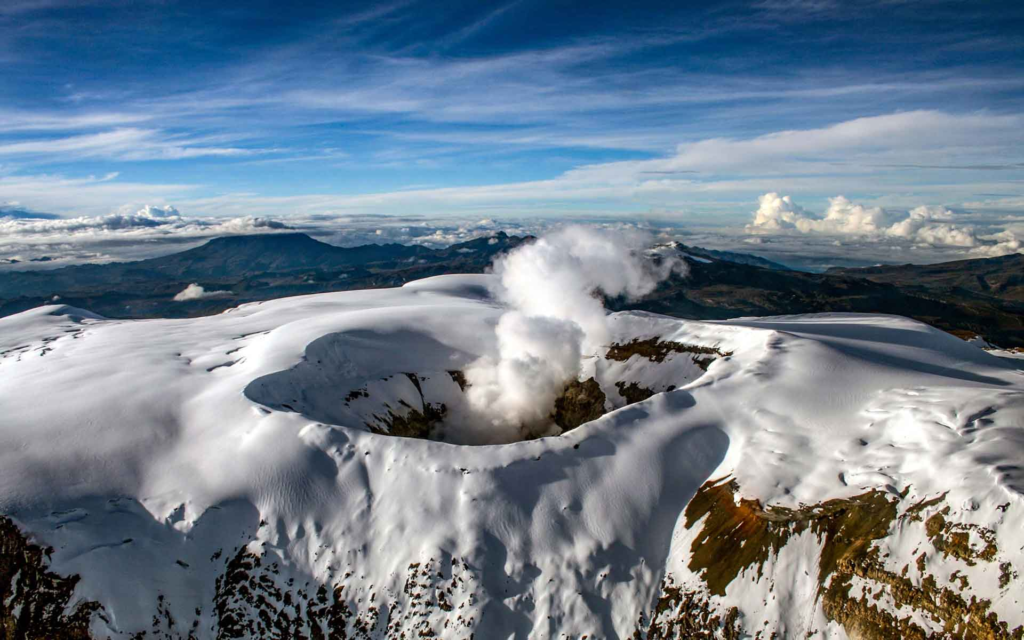
Image Credit: IUGS
The primary agent of the widespread destruction consisted of a pyroclastic mudflow identified as a lahar, which the volcanic eruption set in motion. Intense heat generated by the volcanic activity caused the glaciers covering the summit of Nevado del Ruiz to melt. The melting process released large volumes of water that mixed with volcanic ash, soil, and rock debris. These mixtures formed dense torrents that traveled rapidly down the slopes of the mountain. The town of Armero received the impact of three successive lahars. Many individuals who had remained alive after the initial eruptive phase lost their lives during the passage of these mudflows. Scientific assessments had already indicated the potential magnitude of the eruption and the associated hazards. The absence of fully developed evacuation procedures contributed to the overall scale of the losses.
Omayra Sánchez: A Symbol of Tragedy
Image Credit: World Atlas
One of the many individuals affected by the disaster was 13-year-old Omayra Sánchez Garzón. Her situation drew sustained international attention. The debris and volcanic mud trapped her in place. Omayra came to represent the full measure of the tragedy that overtook Armero. Rescue teams conducted repeated efforts to free her from the material that held her. Those efforts did not succeed in extracting her. For a period of three days Omayra remained fixed in the wreckage of her former home. A heavy brick door secured her legs, and the arms of her deceased aunt rested against her feet.
The Haunting Image: Frank Fournier’s Iconic Photograph
Image Credit: Jeffrey Marso, USGS geologist, Public domain, via Wikimedia Commons
Photographer Frank Fournier recorded the scene of Omayra’s confinement. The resulting image circulated widely and became closely associated with the entire disaster. The photograph displayed Omayra’s eyes, which appeared deeply reddened and almost black in tone. Viewers across many countries responded to the visual record. Fournier later described the moment he captured, stating, “She was facing death with courage and dignity.” The distribution of the photograph generated extensive public discussion and increased general knowledge of the events that had taken place in Armero.
The Dilemma of the Photographer: To Help or to Document?
Image Credit: Geophysical Institute of Peru
Once the photograph reached audiences in multiple countries, certain observers directed questions toward Fournier concerning the decision to record the scene rather than participate in physical rescue attempts. Fournier provided an account to the BBC in which he stated that extraction of the girl from the lahar remained beyond the means available at the site. He recalled the subsequent public response in these terms: “There was an outcry—debates on television on the nature of the photojournalist, how much he or she is a vulture.” He continued, “But I felt the story was important for me to report, and I was happier that there was some reaction; it would have been worse if people had not cared about it.”
The Role of Photojournalism: Capturing Tragedy with Integrity
Fournier offered a detailed explanation of his professional approach. He underscored the value of visual documentation in bringing distant events into public view. He stated, “I am very clear about what I do and how I do it, and I try to do my job with as much honesty and integrity as possible.” In his assessment the photograph contributed directly to the collection of international assistance funds and directed attention toward the limited preparatory measures undertaken by Colombian authorities prior to the eruption. He noted, “I believe the photo helped raise money from around the world in aid and helped highlight the irresponsibility and lack of courage of the country’s leaders.”
Omayra’s Final Hours: A Testament to Human Resilience
Image Credit: World Atlas
During the closing phase of her confinement Omayra displayed a steady composure. Journalists, photographers, and members of the rescue teams remained present around her. She maintained a calm demeanor while her physical condition continued to decline. Those gathered near her position offered songs, pieces of sweet food, and portions of soda in an effort to ease her situation. On the third night of her ordeal Omayra began to speak of experiences that existed outside the immediate surroundings. She mentioned the need to attend school for a mathematics examination. Even while enduring severe discomfort she requested that the individuals who stayed with her take opportunities to rest themselves.
A Heartbreaking Farewell: Omayra’s Last Words
As her physical strength diminished within the surrounding mud, Omayra spoke a final set of statements. The words formed a direct address to the members of her family: “Mommy, I love you so much, daddy I love you, brother I love you.” On November 16, 1985, Omayra died from conditions that medical observers identified as probable gangrene or hypothermia. The three-day period of her confinement thereby concluded. Her brother and her mother both survived the disaster. Her mother later observed, “It is horrible, but we have to think about the living… I will live for my son, who only lost a finger.”
The Lasting Impact: A Call for Accountability
Image Credit: World Atlas
The death of Omayra, together with the deaths of the thousands of other residents of the region, generated extensive public examination of the Colombian government’s preparatory measures and the decisions regarding resident relocation in the period preceding the eruption. The photograph of Omayra continues to function as a persistent visual record of the events and of the human consequences that followed. Fournier summarized the continuing effect of the image with the observation, “People still find the picture disturbing. This highlights the lasting power of this little girl. I was lucky that I could act as a bridge to link people with her. It’s the magic of the thing.”
The sequence of events that began with the volcanic activity on Nevado del Ruiz extended through the formation of the lahars, the inundation of Armero, the prolonged confinement of Omayra Sánchez Garzón, the creation and distribution of Frank Fournier’s photograph, and the subsequent public responses. Each stage of the narrative retains its original order and factual content. The descriptions of the melting of the summit glaciers, the rapid descent of the mudflows, the repeated rescue efforts, the three days of Omayra’s presence within the debris, the exact wording of the statements she and others made, and the later reflections offered by the photographer remain unchanged in substance. The expanded account presents these elements across multiple separate paragraphs so that each phase of the history receives clear and sustained attention. The town of Armero, the mountain itself, the specific date of November 13, 1985, the number of residents and the recorded fatalities, the identity of Omayra Sánchez Garzón, the role of Frank Fournier, and the quoted remarks all stand in their established places within the overall structure. The resulting text maintains the full chronological progression while offering a continuous and detailed rendering of the disaster and its human dimensions.