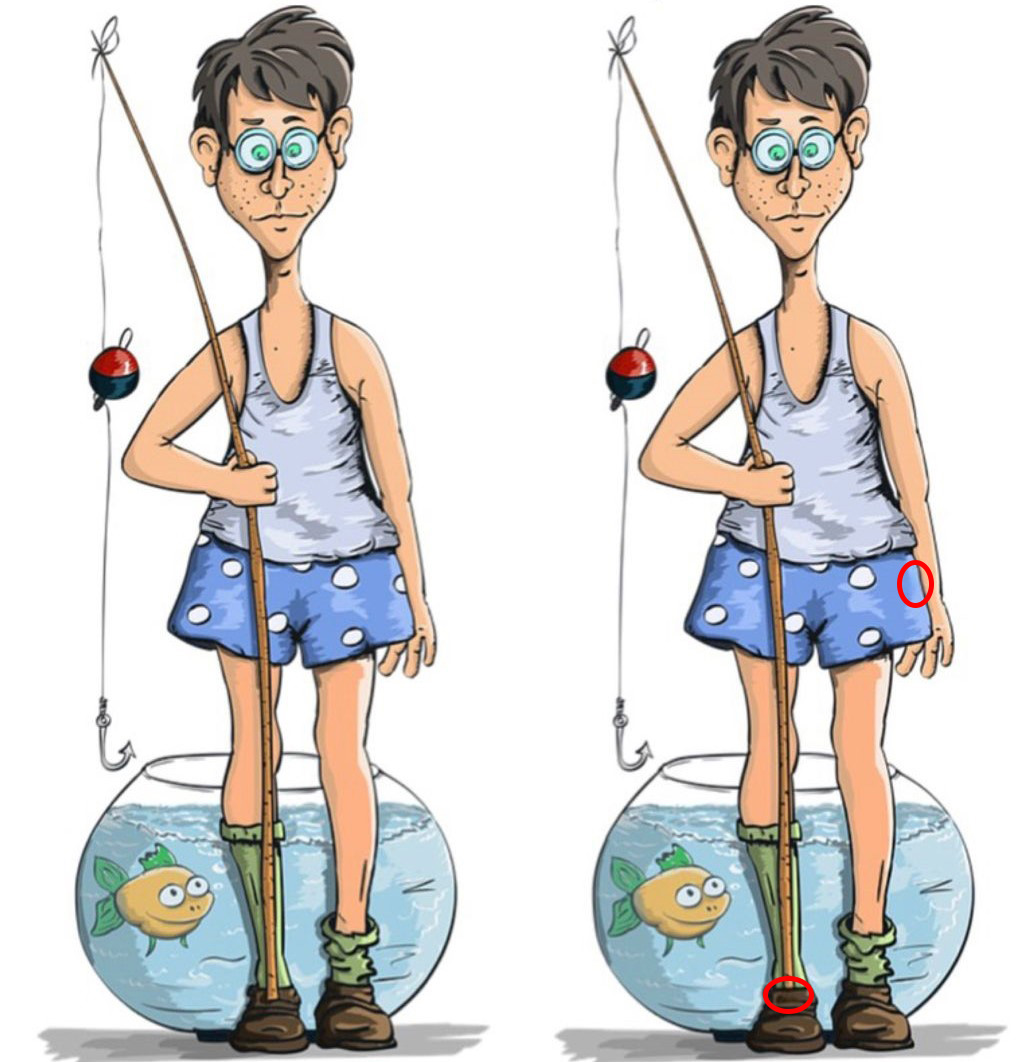
Spot the Single Difference in the Goldfish Bowl Fishing Scene
Welcome back to our daily brain workout!
Are you ready to test your eagle eyes today?
We have a super fun visual puzzle for you right now.
Take a close look at the image above.
You will see a funny boy with glasses standing in a goldfish bowl.
He is holding a long fishing rod.
He is wearing polka-dot shorts.
The two pictures feature the same quirky character.
The two pictures feature the same fish.
The two pictures feature the same funny setup.
There is exactly one tiny difference hidden somewhere between these two images.
The difference might be near his glasses.
The difference might be near his hair.
The difference might be somewhere on his tank top.
The difference might be somewhere on his shorts.
The difference might be hidden along the fishing line.
The difference might be hidden along the hook.
The difference might be hidden along the float.
The difference might be down near his socks.
The difference might be down near his shoes.
The difference might be inside the fishbowl.
Your mission today is to spot that single odd detail as fast as you can.
Stay focused during the search.
Scan the image carefully from the top to the bottom.
Pay attention to every small line.
Pay attention to every color.
People with sharp eyes can spot the difference in less than ten seconds.
You can join the group of eagle-eyed puzzlers today.
Challenge your brain.
See how quickly you can find the difference.
Take your time with the observation.
Zoom in if you need to examine details more closely.
When you think you have found the answer, leave a comment below.
Tell us where the difference is hidden.
Keep the location details free of spoilers for others.
Good luck with the search.
Keep your eyes open.
Have fun puzzling!
ANSWER:
The puzzle presents a single scene repeated in two side-by-side frames. The central figure is a boy wearing glasses. He stands inside a large goldfish bowl filled with water. A fishing rod extends from his hands. Polka-dot shorts cover the lower part of his outfit. Several goldfish swim around him inside the bowl.
Every major element appears in both frames. The boy’s posture remains consistent. The angle of the fishing rod remains consistent. The placement of the fish remains consistent. The shape of the bowl remains consistent. The overall composition matches from one image to the other.
A single small variation exists between the two versions. The variation is limited to one precise location. Careful visual comparison is required to locate it. Systematic scanning from the top of the image downward increases the chance of detection. Examining the area around the glasses provides one starting point. Examining the hairline provides another starting point. Examining the fabric of the tank top provides a further starting point. Examining the pattern on the shorts provides an additional starting point.
The fishing equipment offers several possible sites for the change. The length of the line can be checked. The shape of the hook can be checked. The position of the float can be checked. Lower portions of the figure also deserve attention. The socks can be compared. The shoes can be compared. The interior of the fishbowl can be compared for any alteration in water level, fish placement, or bowl markings.
Focus supports accurate detection. Moving the eyes slowly across each section of the image helps. Noting the direction of every line helps. Noting the shade of every color helps. Repeating the scan a second time often reveals a detail missed on the first pass.
Many participants enjoy timing themselves during the search. Completing the identification in under ten seconds places the observer among those with especially quick visual discrimination. Longer observation times remain fully valid and often lead to the same correct finding.
Once the difference is located, a comment can record the discovery. Describing the general area without giving away the exact change preserves the challenge for later viewers. Sharing the experience of the search adds to the collective activity.
The puzzle belongs to a long tradition of visual discrimination exercises. Such exercises train attention to fine detail. They encourage patient examination of complex scenes. They reward careful observation with the satisfaction of locating a subtle change.
The boy’s humorous placement inside the goldfish bowl creates an engaging central subject. The fishing rod adds a narrative element to the scene. The polka-dot shorts contribute a playful pattern that invites close inspection. The swimming goldfish supply additional small shapes that can be compared across the two frames.
Successful completion of the task depends on steady attention rather than speed alone. Multiple passes across the image frequently uncover the variation. Adjusting screen brightness or enlarging the view can assist when the difference is especially minute.
The activity offers a brief mental exercise suitable for any time of day. It requires no special equipment beyond the ability to examine the paired images. Participation remains open to everyone who wishes to test their visual sharpness.
After locating the single difference, the observer can return to the image and verify the finding once more. Confirmation strengthens confidence in the result. The process of searching itself provides the main benefit of the puzzle.
Comments that note the discovery without revealing the precise spot allow others to continue their own independent search. This shared approach keeps the challenge available for the full audience.
The goldfish bowl setting, the fishing rod, the glasses, the polka-dot shorts, and the single hidden variation together form a complete visual task. Careful, systematic examination leads to the solution. Enjoy the process of looking closely and noticing what stands out between the two frames.